
Trend-Following Primer
The Enduring Edge of Trend Following

Trend-following has been a staple of successful trading for decades. What makes it so effective is also what makes it so difficult: it's reactive, not predictive. It doesn’t care about opinions, narratives, or forecasts. It just follows price.
We love it because it's robust, adaptable, and brutally honest. But it’s not for everyone.
The psychological toll is real. Trend strategies can go through long periods of stagnation, drawdowns, and underperformance—especially in sideways markets. Most people can’t handle that. They bail too soon, tweak too often, or lose faith entirely. That’s why we believe trend following will continue to work: not because it's easy, but because it's hard and most traders simply don’t have the discipline to stick with it.
Core Principles of Trend Following
Trend following is based on the premise that markets tend to move in persistent directions over extended periods. The goal is to identify and ride these upward or downward trends across multiple asset classes. Markets are messy. They’re driven by fear, greed, central banks, geopolitics, memes, and momentum. Trying to predict what happens next is tempting—but often futile. Trend following flips the script: it doesn’t predict, it reacts.
It’s a rules-based strategy that thrives when prices move in sustained directions. Think oil in the 2000s, bonds in the '80s, tech stocks in the 2010s, or Bitcoin in 2020. When markets move, trend followers don’t argue—they ride.
This approach has been around for decades, and despite market changes, it’s still quietly doing its job.
Key Characteristics
Momentum-based: Trend followers buy assets showing upward momentum and sell those with downward momentum 1.
Reactive approach: Rather than predicting future price movements, trend followers react to existing market trends 1.
Diversification: Strategies are applied across many markets simultaneously to enhance consistency 2.
Risk management: Position sizing and stop-loss orders are crucial for managing downside risk 3.
Common Indicators
Trend followers often use technical indicators to identify and confirm trends:
Moving Averages: Simple or exponential moving averages help smooth out price data.
Breakout Systems: Identifying when prices break above or below critical levels.
Momentum Indicators: Rate of Change, all-time highs/lows, and others to gauge trend strength.
Here’s an example of a simple and creative momentum-based trend-following system: https: //www.followingthetrend.com/2014/03/free-trend-following-trading-system-rules/
Historical Development
The trend-following strategy can be traced back to the saying "Cut short your losses, and let your profits run." David Ricardo (19 April 1772 – 11 September 1823) was an English political economist. The trend-following approach gained prominence in the early 20th century, with notable figures like Richard Donchian pioneering systematic approaches in the 1960s.
1970s-1980s: The Turtle Traders
In 1983, famous commodities trader Richard Dennis conducted an experiment to prove that successful trading could be taught. He trained a group of novices, dubbed the "Turtle Traders," in trend following techniques. Their remarkable success brought widespread attention to the strategy 3.
1990s-2000s: Expansion and Sophistication
As financial markets became more accessible and data-driven, trend following strategies evolved:
Increased computing power: Allowed for more complex algorithms and faster execution.
New markets: Expansion into emerging markets and new asset classes.
Risk management: Development of more sophisticated position sizing and portfolio construction techniques.
Performance Across Decades
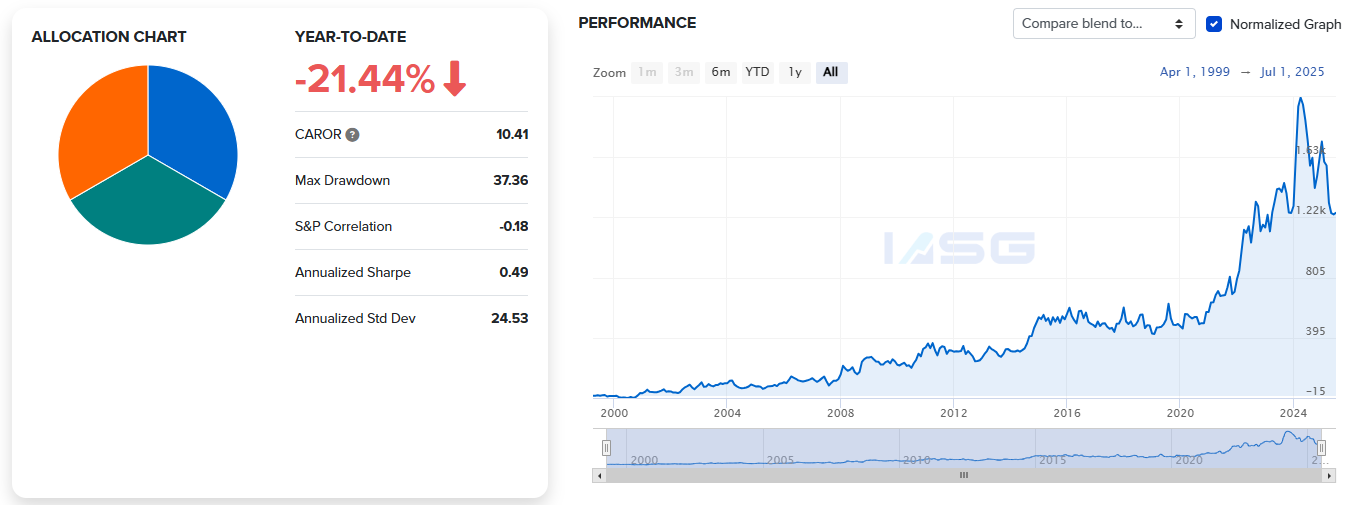
Trend following has consistently delivered positive returns over decades—often with low correlation to traditional asset classes like stocks and bonds.
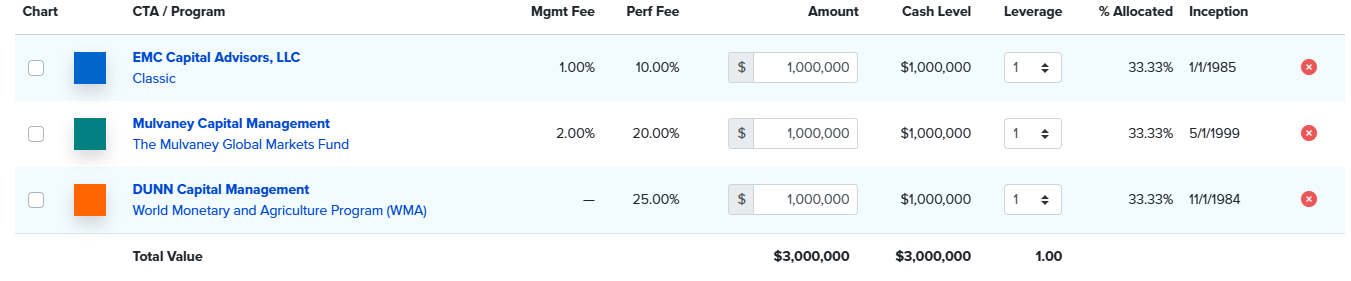
To illustrate this, I pulled data from IASG, a free database of Commodity Trading Advisors (CTAs), and built an equal-weighted portfolio using publicly available returns. The result isn’t a backtest or optimized model—it’s a simple demonstration of how diversified trend-following strategies have performed over time.
1970s-1980s: The Golden Age
This period saw exceptional returns for trend followers, particularly in commodities markets. Factors contributing to success included:
High inflation leading to strong trends in commodities.
Less efficient markets with fewer participants.
Limited access to information creating longer-lasting trends.
1990s: Mixed Results
The 1990s presented challenges for trend followers:
Stock market boom: Equities showed persistent uptrends, benefiting some strategies.
Reduced commodity volatility: Made trend identification more difficult in these markets.
Increased competition: More traders adopting similar strategies led to crowded trades.
2000s: Resurgence
The decade saw a revival in trend following performance:
Dot-com bubble burst: Provided opportunities in downward trends.
Commodity super-cycle: Strong trends in oil, metals, and agricultural products.
2008 Financial Crisis: Trend followers profited from sharp declines across multiple asset classes.
2010s-Present: Adaptation and Evolution
Recent years have presented both challenges and opportunities:
Low interest rate environment: Reduced trends in fixed income markets.
Increased market efficiency: Shorter-lived trends in some asset classes.
New asset classes: Cryptocurrencies have provided new trending markets.
Machine learning: Integration of AI/ML techniques to enhance trend identification and execution.
Modern Trend Following Tactics
Today's trend-following strategies often incorporate advanced techniques to improve performance and adapt to changing market conditions. Traders analyze trends across multiple timeframes to confirm signals and reduce false positives. For example:
Long-term trend: Identified on weekly or monthly charts
Entry timing: Fine-tuned using daily and intraday charts
Dynamic lookback periods: Adjusting moving average lengths based on market volatility
Volatility-based position sizing: Increasing or decreasing exposure based on recent market behavior
Crowded Trades
As more capital has flowed into trend-following strategies, some argue that opportunities have diminished due to increased competition. Trend-following can experience extended drawdowns, particularly in choppy or range-bound markets. This can test the patience of investors and lead to strategy abandonment.
Conclusion
Trend following has demonstrated remarkable longevity as a trading strategy, adapting to changing market conditions over decades. While past performance does not guarantee future results, the core principles of trend following remain relevant in today's financial landscape:
Riding momentum
Managing risk
Diversifying across markets
Successful trend following requires discipline, robust risk management, and market evolution. As financial markets continue to change, trend followers who can adapt their tactics while staying true to these fundamental principles are likely to find continued success.